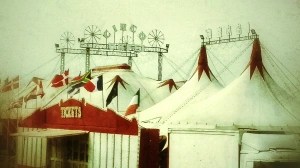
fairy lights twinkling
paint a pathway to the stars
barkers hawking dreams
step right up, come on inside
costumed carnies everywhere
riding, tumbling, flying high
bears in tutus lions’ dance
sticky sweets galore
wide eyed children gasp
clown car set ablaze
sire’s soothing arms swoop in
all underneath the big top
ah, the good old days
For this week’s Tanka Tuesday we have been asked to create a piece of formed poetry that uses synonyms for the words; Create and Bright. I have chosen a form called a kouta, the explanation of which follows if you are so inclined. Oh, and just an FYI- ‘surreale’ is the photographer’s notation on this photograph, not the title of this poem.
kouta
The kouta is a popular Japanese verse form of the Muromachi Period, 14th thru 16th century. They resurrected the lyrical song as a geisha song in the late 1800s and it’s still popular today. Koutas were originally meant to be sung out loud, like many other old forms of poetry. Techniques like assonance and consonance would fit right in with the form, but they aren’t required.
The kouta has several variations, though always short in only 4 lines a 5th line is sometimes is added. Themes reflect ordinary life and often use colloquialisms and onomatopoeia. The most popular are love songs.
We write kouta in four lines but sometimes five, that tends to celebrate the average person’s everyday life in song. This is a standalone poem, but often it’s accompanied by other kouta with the same theme. Themes can be secular, personal, or themes about ordinary life.
Do try to take advantage of short words that stand alone well, since the lines are a bit short by English standards.
You may want to avoid using too many adverbs and adjectives.
“Each individual kouta is very short, so you’ll find yourself with less and less space if you use flowery, decorative language instead of clear, concise phrasing.” (wordwool.com)
Koutas use odd-numbered syllable lengths, usually as some combination of five-syllable and seven-syllable lines. We write the most common patterns in four lines of alternating 7-5-7-5 syllables or 7-7-7-5 (not to be confused with the mondo form) though these are only two possible variations. No rhyming. No title.
 Thru Violet's Lentz
So beautifully written Violet.
LikeLiked by 1 person
Thank you, Sadje. Form is not my forte, but I did enjoy this little trip to the Circus!
LikeLiked by 1 person
You did it well my friend
LikeLiked by 1 person
Complimenti! 🙂
LikeLiked by 1 person
You saw it! I am so happy you came for a look. I appreciate being able to use your photos so much. They add life to my words by their very presence!
L’hai visto! Sono così felice che tu sia venuto a dare un’occhiata. Apprezzo molto il fatto di poter usare le tue foto. Aggiungono vita alle mie parole con la loro stessa presenza!
LikeLiked by 1 person
Grazie! 😉
LikeLiked by 1 person
Beautiful and haunting
LikeLiked by 1 person
Circuses seem to have all but disappeared so I thought it would be a nice little trip for those who have never been. Thank you, Aastha, for stopping by and welcome to my little corner of the world!
LikeLiked by 1 person
I loved it! Keep writing more ❤
LikeLiked by 1 person
Thank you. The photographer who allowed me to use that phot has more intriguing ones, I just might work on something else.
LikeLike
I learn something new with each of your posts ❤️🔥 wonderful Violet thank you🙏🏻
LikeLiked by 1 person
Thank you, JAM., I am so happy you are enjoying my writing.
LikeLiked by 1 person
I admire poet, but I can’t stand their power for words.🤭 It’s so deep sometimes.
Lovely as always, violet. It sounds like poems are complicated to write for me.🙈
LikeLiked by 1 person
I understand, Hazel. And formed poetry is particularly hard to decipher because we are working with in parameters that you cannot see while you are reading them.
LikeLiked by 1 person
It’s like you want to say a story in just a few words. I have no talent for that, and I admire you.
LikeLiked by 1 person
Love the poem, especially the last line 😊
LikeLiked by 1 person
Is it just me, or have circuses gone the way of the typewriter? Thanks for stopping by this morning.
LikeLiked by 1 person
Haha. It’s just you ☺️ My pleasure!
LikeLiked by 1 person
Your words brought the carnival to life. Brava, Violet!
LikeLiked by 1 person
So few get to experience it anymore, I thought it would be a nice fieldtrip.
LikeLiked by 1 person
You had a wonderful image to work with there.
Your words captured the essence of it perfectly.
LikeLiked by 1 person
So much credit due the amazing creator over at Blog 57. I have been privileged to work with them on several occasions. and the collaboration is always stunning. I went with the Circus, as I think it is a faded if not near extinct art form. Thank you, Maggie for being such a faithful addition to the commentary over here.
LikeLiked by 1 person
It is a stunning piece of art Violet 🤗
It is my pleasure to read your work my friend.
LikeLiked by 1 person
Wonderful poem!
LikeLiked by 1 person
Thank you, Shreya for joining in the conversation.
LikeLiked by 1 person
Love the way you are always teaching and writing beautiful things for us to taste. Thank you.
LikeLiked by 1 person
Thank you! I love being able to say something I read is delicious, and it is certainly a welcome complement to hear it. I think this may be the first time.
LikeLiked by 1 person
When I was young, I once thought about running away and joining the circus but, then I thought again and started my own. I like your circus here, and I learned. What a great way to learn.
LikeLiked by 1 person
I will admit to my life resembling a circus act at times- but then I’d also have to admit that lately it’s been one long boring intermission!
LikeLiked by 1 person
Beautiful imagery and delightful nostalgia, Violet! ❤️
LikeLiked by 1 person
It was the nostalgia for me. Thank you, Cheryl.
LikeLiked by 1 person
Your poem is wonderful, Violet! Thank you for explaining in the details below. I love to learn things about poetry.
LikeLiked by 1 person
My pleasure Kymber. I’m with you, I love learning new things.
LikeLiked by 1 person
Now I want to go to the circus!
LikeLiked by 1 person
me too 😀
LikeLiked by 2 people
Me too! We never get them here, I don’t know if they are still a thing in the lower 48 or not….
LikeLike
Not so much here in NY. I took my grands once; it wasn’t the same without the animals. Awful mistreatment of animals ended that era. People will never learn.
LikeLiked by 1 person
We get the same hate for sled dogs being run up here. All I can say, is anyone who truly believes they are being mistreated has never actually met a sled dog. Now that’s not to say there aren’t evil humans out there, because there are, but running sled dogs professionally is not an occupation that would attract too many hate filled people- there’s way too much work to be done from before dawn till after dusk.
LikeLiked by 1 person
Jack London’s classic The Call of the Wild; recommend reading but I don’t see how this iconic book could have gotten by you.
LikeLiked by 1 person
Absolutely read that and White Fang. I think he’s required reading up here!
LikeLiked by 1 person
You captured the magic of the circus from my childhood, Violet. A beautiful kouta, a new form for me. I love the idea that it was conceived as a song about an ordinary person’s day – at the circus in this case. Lovely.
LikeLiked by 1 person
That was the selling point on this form for me, Diana, an ordinary person’s day. I can do that. Thanks for the kind words!
LikeLiked by 1 person
❤
LikeLiked by 1 person
Violet, I’m so happy you’re embracing syllabic poetry and having fun with the different forms. I enjoyed this trip to the circus.
LikeLiked by 1 person
Thank you, Colleen I enjoyed being your tour guide.
LikeLiked by 1 person
Thank you.❤️
LikeLiked by 1 person
Oh my, this took me back! Delightful!
LikeLiked by 1 person
I know right?
LikeLike
This is delightful, Violet
LikeLiked by 1 person
Thank you, Roberta, I guess I just felt it was time for a field trip.
LikeLike
💜🪻
LikeLiked by 1 person
Magical and delightful, Violet! Just like the circus! They have all but disappeared here too!
LikeLiked by 1 person
Nothing like a day at the circus! I feel for them as so many of them were small privately owned businesses. Thank you for sharing this memory with me.
LikeLiked by 1 person
I agree. You are welcome, Violet.
LikeLiked by 1 person
I went to the circus when I was in grade school and had the best time!
LikeLiked by 2 people
A part of life that’s all but gone…
LikeLiked by 1 person
popcorn, cotton candy, and circus peanuts! bring it …
LikeLiked by 1 person
Yum! Don’t get me started on the sweets!
LikeLiked by 1 person
You brought back some good memories. Great poem, Violet!
Yvette M Calleiro 🙂
http://yvettemcalleiro.blogspot.com
LikeLiked by 2 people
Thank you, Yvette. I’m glad you connected with it.
LikeLiked by 1 person
I actually remember going to a circus (perhaps in Madison Square Garden)… with so many seats so high up it was amazing to see or focus on any one thing. Wondering how some of those animals thought of those ‘good ole days’ being kept in cramped cages. Alas the circus as it was is no more.
LikeLiked by 1 person
No, I am only glad I lived in a time where the sheer spectacular of it was something I got to witness.
LikeLiked by 1 person
Lovely.
LikeLiked by 1 person
Thank you, Mary. This was a fun write.
LikeLike
I like the barkers and the bears, there is something sinister about the scene, too (as with clowns), and it was good to know about the form you chose to shape these words
LikeLiked by 1 person
Thank you, Freddie. The familiarity of this form really lent itself to this type of a poem. Welcome to my little corner of the world.
LikeLike
Enjoy your writing!
LikeLiked by 1 person
Thank you, Freddie
LikeLike
The form I choose to shape my words is so important
I often write haiku and tanka as well as other forms, often also playing with the form, twisting it a bit, – form is key, although quite hard to talk about/explain, – partly because few people are interested in that topic 😀
LikeLiked by 1 person
Right you are. I find it binding at times as I am more interested in writing about human nature than Mother nature, but this particular form will find itself on my palette again, I am sure.
LikeLike